The organizations listed below are working hard to end cervical cancer. For more information about their efforts, please visit their websites. .

Women with early cervical cancers and pre-cancers usually have no symptoms. Symptoms often do not begin until the cancer becomes invasive and grows into nearby tissue. When this happens, the most common symptoms are:
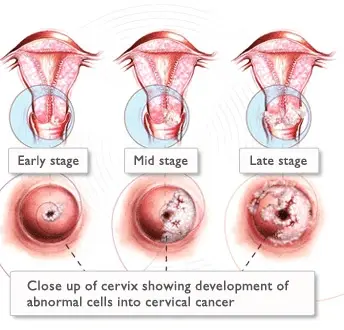
The endocervix (closest to the uterus) is lined with glandular cells.
The ectocervix (next to the vagina) is covered in squamous cells.
Pain during sex.
These signs and symptoms can also be caused by conditions other than cervical cancer. For example, an infection can cause pain or bleeding. Still, if you have any of these symptoms, see a health care professional right away. Ignoring symptoms may allow the cancer to grow to a more advanced stage and lower your chance for effective treatment.


Survival rates tell you what percentage of people with the same type and stage of cancer are still alive a certain amount of time (usually 5 years) after they were diagnosed. They can't tell you how long you will live, but they may help give you a better understanding about how likely it is that your treatment will be successful. Some people will want to know the survival rates for their cancer, and some people won't. If you don't want to know, you don't have to.
Statistics on the outlook for a certain type of cancer are often given as 5-year survival rates. The 5-year survival rate is the percentage of people who live at least 5 years after being diagnosed with cancer. For example, a 5-year survival rate of 70% means that an estimated 70 out of 100 people who have that cancer are still alive 5 years after being diagnosed. Keep in mind, however, that many of these people live much longer than 5 years after diagnosis. But remember, all survival rates are estimates - your outlook can vary based on a number of factors specific to you.
Survival rates are often based on previous outcomes of large numbers of people who had the disease, but they can't predict what will happen in any particular person's case. There are a number of limitations to remember:
The rates below were published in 2010 in the 7th edition of the AJCC staging manual. They are based on data collected by the National Cancer Data Base from people diagnosed between 2000 and 2002. These are the most recent statistics available for survival by the current staging system.

Remember, these survival rates are only estimates - they can't predict what will happen to any individual person. We understand that these statistics can be confusing and may lead you to have more questions. Talk to your doctor to better understand your specific situation.